They were twins but little about their appearances, lifestyles or personalities suggested the Bird brothers were alike.
Their teachers had observed the differences between them as children; as adults they lived lives apart.
In any other family the distance between them would have been unremarkable but for these men it was to have tragic consequences.
It emerged yesterday that David Bird was the first victim of the Cumbria massacre. In the early hours of Wednesday morning his brother Derrick entered his luxury home and shot him in a brutal act of fratricide that was a prelude to the rampage that ended with mass murder and suicide.
Read more of the splash of today's edition of The Times, currently the most read story at timesonline. I have a joint by-line on the
most commented story and a joint by-line on Thursday's splash.
Saturday, 5 June 2010
Monday, 24 May 2010
Notes on the road from Arusha
Below, some random observations from the trip last week to Tanzania. You can link to the article in the Times, by scrolling down to the following post, entitled At last, intelligent aid for Africa's poor.
Wherever we went, town or country, there were hundreds, thousands of people walking. Walking along the roads, across the countryside, children in smart school uniforms disappearing across the vibrantly green fields, towards unseen schools or homes, women with bales on their heads, Maasai men with their red and black cloaks and sticks, all just ambling along. There's a beautiful rhythm to this movement, almost hypnotic, and it's something which goes on and on, from dawn to dusk.
The Indian community in Tanzania is much older than the Indian community in Britain, though presumably it owes its origins to the same thing - the British Empire. We saw the remnants of the old colonial culture languorously displayed on Sunday at the TGT Club on the edge of Arusha city. It's an old sports club, built alongside a coffee plantation, now in the hands of American owners. On the field opposite the pavilion, a group of Indian men were playing cricket, while the predominantly white diners in the restaurant and bar looked on. The different cultures and origins of the residents have some curious results: Paolo, 13, born in Arusha to a Belgian mother and an Italian father, was a huge cricket fan, and (by all accounts) a very good player. Doubtless, he'll qualify to play for England soon enough.
There are unintended consequences to the Galvmed story. The charity's ambition is to wipe out 13 livestock diseases and this objective will almost certainly be realised, perhaps even within a decade. The benefits for remote, poor farming communities across Africa are incalculable, increasing wealth and food security exponentially. The same process will change communities forever, a trend already under way in the Maasai communities we visited. These are farmers who, for generations, have been used to losing most of their calves to disease - but now almost all are surviving. Calves vaccinated at a cost of £5 sell for £350 at market.
In other words, a herd of 300 is worth a huge amount, in anyone's money and some of these pastoralists are rapidly becoming rich. As these individuals gain wealth, the communities around them are changing: there are plenty of traditional huts and bomas (farmsteads), and most of the people we met dressed in Maasai shawls - but other dwellings have replaced their straw roofs with corrugated iron, some houses in remote communities are built of concrete, and a few people own cars and lorries. When we were out in the countryside, in the early morning, Noah Lemorongo, the 40-year-old chairman of the Engarenaibor community asked me in English whether I owned a motorbike. I couldn't understand why. At lunchtime, as we walked away from a bustling village market, he drove up to show off the shining bike he'd bought himself, as if to show off his wealth. Still, as these communities change, it is very striking how many of the younger Maasai choose to remain in the countryside, close to the heart of their traditional way of life. (Note: The photo shows the chairman and half of my fat head, an image that proves the equation: "Wade + baseball cap = Michael Moore.")
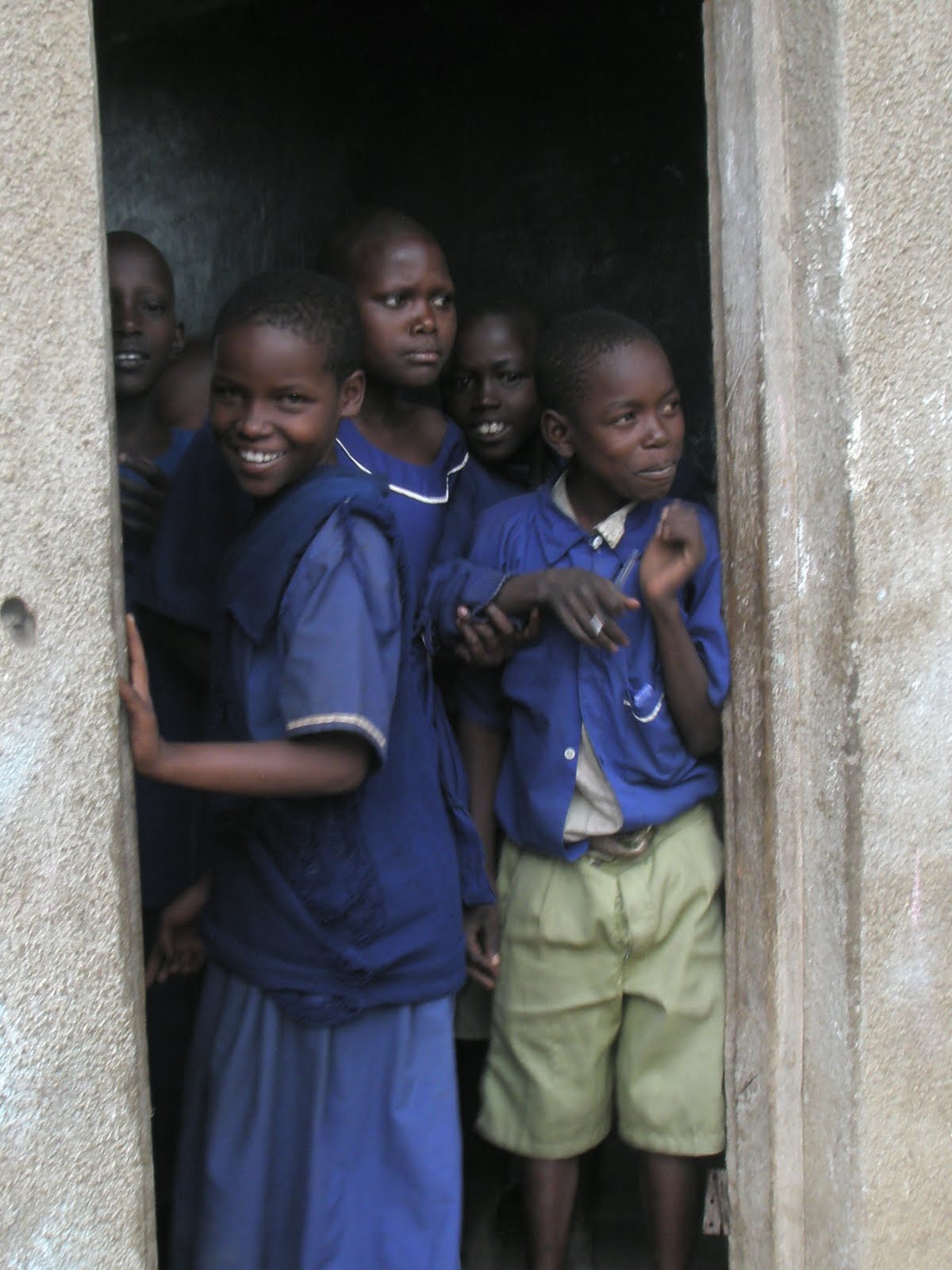
The school we visited was blessed with Anna Remi Nchira, a headmistress of outstanding quality. She reminded me very much of the headmistress at my daughters' school in Edinburgh, as if there is some essence of headmistress that is shared across the world. A group of guys from a Western charity and a British newspaper represented important guests - she wasted no time in very formally welcoming us, and, then, just as she should have done, making demands of us, asking us to help her pupils and teachers.
Just as the walkers in the countryside give a glimpse of what like must have been like in pre-industrial Britain, Arusha City (population: 1 million) has the whiff of 18th and 19th century London. It's the whiff of cattle, hundreds, probably thousands of cattle, which are kept in small holdings, right at the heart of the the city, enabling the locals to have access to a constant supply of rich, untreated milk.
Local buses are illuustrated with pictures of great Tanzanian heroes. Here's one we spotted near Arusha coach station. Reading right to left: Barack Obama, Martin Luther King, Michelle Obama, Benjamin Mkapa and Julius Nyrere (both obscured) Nelson Mandela, Mother Theresa, and ... that's right, pop pickers, Lionel Richie.
Wherever we went, town or country, there were hundreds, thousands of people walking. Walking along the roads, across the countryside, children in smart school uniforms disappearing across the vibrantly green fields, towards unseen schools or homes, women with bales on their heads, Maasai men with their red and black cloaks and sticks, all just ambling along. There's a beautiful rhythm to this movement, almost hypnotic, and it's something which goes on and on, from dawn to dusk.
The Indian community in Tanzania is much older than the Indian community in Britain, though presumably it owes its origins to the same thing - the British Empire. We saw the remnants of the old colonial culture languorously displayed on Sunday at the TGT Club on the edge of Arusha city. It's an old sports club, built alongside a coffee plantation, now in the hands of American owners. On the field opposite the pavilion, a group of Indian men were playing cricket, while the predominantly white diners in the restaurant and bar looked on. The different cultures and origins of the residents have some curious results: Paolo, 13, born in Arusha to a Belgian mother and an Italian father, was a huge cricket fan, and (by all accounts) a very good player. Doubtless, he'll qualify to play for England soon enough.
There are unintended consequences to the Galvmed story. The charity's ambition is to wipe out 13 livestock diseases and this objective will almost certainly be realised, perhaps even within a decade. The benefits for remote, poor farming communities across Africa are incalculable, increasing wealth and food security exponentially. The same process will change communities forever, a trend already under way in the Maasai communities we visited. These are farmers who, for generations, have been used to losing most of their calves to disease - but now almost all are surviving. Calves vaccinated at a cost of £5 sell for £350 at market.
In other words, a herd of 300 is worth a huge amount, in anyone's money and some of these pastoralists are rapidly becoming rich. As these individuals gain wealth, the communities around them are changing: there are plenty of traditional huts and bomas (farmsteads), and most of the people we met dressed in Maasai shawls - but other dwellings have replaced their straw roofs with corrugated iron, some houses in remote communities are built of concrete, and a few people own cars and lorries. When we were out in the countryside, in the early morning, Noah Lemorongo, the 40-year-old chairman of the Engarenaibor community asked me in English whether I owned a motorbike. I couldn't understand why. At lunchtime, as we walked away from a bustling village market, he drove up to show off the shining bike he'd bought himself, as if to show off his wealth. Still, as these communities change, it is very striking how many of the younger Maasai choose to remain in the countryside, close to the heart of their traditional way of life. (Note: The photo shows the chairman and half of my fat head, an image that proves the equation: "Wade + baseball cap = Michael Moore.")
The school we visited was blessed with Anna Remi Nchira, a headmistress of outstanding quality. She reminded me very much of the headmistress at my daughters' school in Edinburgh, as if there is some essence of headmistress that is shared across the world. A group of guys from a Western charity and a British newspaper represented important guests - she wasted no time in very formally welcoming us, and, then, just as she should have done, making demands of us, asking us to help her pupils and teachers.
Just as the walkers in the countryside give a glimpse of what like must have been like in pre-industrial Britain, Arusha City (population: 1 million) has the whiff of 18th and 19th century London. It's the whiff of cattle, hundreds, probably thousands of cattle, which are kept in small holdings, right at the heart of the the city, enabling the locals to have access to a constant supply of rich, untreated milk.
Local buses are illuustrated with pictures of great Tanzanian heroes. Here's one we spotted near Arusha coach station. Reading right to left: Barack Obama, Martin Luther King, Michelle Obama, Benjamin Mkapa and Julius Nyrere (both obscured) Nelson Mandela, Mother Theresa, and ... that's right, pop pickers, Lionel Richie.
Saturday, 22 May 2010
At last, intelligent aid for Africa
It is a little after dawn in the Maasai district of Engarenaibor in northwestern Tanzania. Amid a pre-historic landscape of rolling grassland and acacia trees, Paolo Lemorongo, a farmer, is rounding up cows, so that his visitors can see for themselves the tiny yellow tags that have been attached to each animal’s ear. The tag signifies an animal inoculated against the deadly Ndigana kali, better known as East Coast fever.
“Before the vaccination became available, most of my animals died,” says Mr Lemorongo. “If the cows delivered 80 calves, only five would survive. Of course, when vets first brought the treatment here some people were suspicious, but when they saw that so many animals survived, suddenly everyone wanted it.”
Mr Lemorongo, whose home is a four-hour drive by Land Rover from Arusha, the nearest city, is understandably delighted to be the beneficiary of a ground-breaking aid project, developed by Galvmed (Global Alliance for Livestock Veterinary Medicines). This Edinburgh-based charity was founded five years ago with the aim of halting East Coast fever and 12 other deadly livestock diseases that lay waste to millions of animals every year across the African continent and throughout the developing world.
It seems an unfeasibly large ambition...
... and it is hugely ambitious. The whole article is here Galvmed's intelligent aid. Strangely, this article is filed under "Scotland" at Times online; also the paper printed the word Maasai as Masai, I know not why. All of which is rather a shame, because this is a fantastic aid project, which deserves to be widely reported.
The photo is by me, for once. James Glossop took some fantastic pix, four of which you can see on the Times site, and more on his Times blog, when he gets round to putting them up.
“Before the vaccination became available, most of my animals died,” says Mr Lemorongo. “If the cows delivered 80 calves, only five would survive. Of course, when vets first brought the treatment here some people were suspicious, but when they saw that so many animals survived, suddenly everyone wanted it.”
Mr Lemorongo, whose home is a four-hour drive by Land Rover from Arusha, the nearest city, is understandably delighted to be the beneficiary of a ground-breaking aid project, developed by Galvmed (Global Alliance for Livestock Veterinary Medicines). This Edinburgh-based charity was founded five years ago with the aim of halting East Coast fever and 12 other deadly livestock diseases that lay waste to millions of animals every year across the African continent and throughout the developing world.
It seems an unfeasibly large ambition...
... and it is hugely ambitious. The whole article is here Galvmed's intelligent aid. Strangely, this article is filed under "Scotland" at Times online; also the paper printed the word Maasai as Masai, I know not why. All of which is rather a shame, because this is a fantastic aid project, which deserves to be widely reported.
The photo is by me, for once. James Glossop took some fantastic pix, four of which you can see on the Times site, and more on his Times blog, when he gets round to putting them up.
Saturday, 1 May 2010
Goldsworthy's shadowlands
Inside a comfortable stone farmhouse, deep in the rolling hill country of Dumfries and Galloway, conversation has taken an unexpected turn. This is the home of Andy Goldsworthy, the world’s foremost environmental artist. It’s a beautiful spring day, he has spent the morning in the fresh air and the time is surely ripe to discuss the joys of the British countryside. But almost unbelievably, from his seat under one of his huge muddy “paintings” — literally, Sheep’s Footprints on Canvas — the artist has suddenly managed to transport himself to the streets of New York.
You are not going to credit this, he says, his keen eyes shining with laughter, but he was almost arrested by the NYPD a month ago — simply for being an artist. He’d been trying to make rain shadows outside the Rockefeller Centre. His plan was to lie down on the pavement, just as a shower began, so that the dry shape of his body would remain after the raindrops soaked the concrete around him. Alas, as soon as he set about his work the long arm of the law intervened. “There is a video of me being evicted from outside Fox News,” Goldsworthy snorts. “Corporate America has such a fear of a terrorist attack. They own the bloody sidewalk.”
So he was frogmarched away? “Oh, yeah. To be honest, the police were great about it. They wanted to know what I was doing but they were OK. The security guards simply would not look me in the eye. I said to one guy, ‘What’s wrong with the world? I had far more freedom in Moscow when it was under communism than I have had in New York this week’. It really was oppressive.”
Goldsworthy’s Gotham City adventure seems absurdly out of character. Here is an artist who, through three decades, has elevated drystone walling to high art, built rivers of stone and clay in parks and galleries across Europe and America, and can make rocks appear to bleed by covering their sharp edges with red autumnal leaves, glued down with spit.
With this body of work it is easy to see how he can be labelled “the British countryside’s most engaging propagandist”, though such descriptions make him shake his head. He has never been a campaigner for an unspoilt rural idyll. As a new book celebrating his permanent works makes clear, it is human intervention in nature that fascinate him: the forests we cut down, the land that is grazed, the stone walls and slate bridges that punctuate the view. He despairs of the chocolate-box image of the countryside and worries that his artworks have helped to perpetuate that image.
“I have become more annoyed at that perception about my work — and about the countryside,” he says. “It has become this kind of pastoral backdrop for relaxing weekends. Nature can be relaxing, it can be healing. But it can be brutal and harsh and difficult, too.
“Nature doesn’t stop when you reach the city boundary,” he says, which is why his trip to New York came up in conversation in the first place. He might be sitting within earshot of a skylark, but Goldsworthy insists that there is a direct link between his day-to-day world, deep in the calm of rural Scotland, and the hurly-burly of Manhattan. “What do we leave behind in the city?” he asks, pleading for understanding. “What gives it its life but our human presence? The shadows articulate that very strongly: the rain falling, the shapes on the pavements. It’s about the nature of the city and of the people who occupy it. New York was the first time I had gone and worked with what I’d find on the streets. It’s very much the equivalent of what I do in this place, which people call the countryside.”
Goldsworthy’s adventures on Sixth Avenue are only part of the story. His focus is Man and Nature and he believes his work to be entering a new phase, reflected by his “obsession” with the rain shadows and by the permanent works he is creating. He cites Roof, nine brooding stacked-slate domes, conceived and installed over more than two years at the National Gallery of Art in Washington. “Maybe it’s a way of beginning to flex your muscles and understand things,” he says. “The whole conceptual process, the whole physical act of making it, the scale of it. It is just much more complex.”
Admirers too have registered a new brilliance in his output. When, in a recent essay, Antony Gormley despaired of finding contemporary artists who could address the climate crisis of “our perilous times”, he turned with relief to one of Goldsworthy’s most recent works. From the outside, Stone House – Bonnington, in a wood near Edinburgh, part of the Jupiter Artland sculpture garden, looks innocuous enough. But within the dark interior the earth has been completely cut away, down to the bubbling igneous surface of the bedrock, revealed in the dim light cast from a single window. When Gormley stepped inside he was exultant. He had been shown “the underneath” of everything, “a useless building in which we could encounter our dependency: a brilliant work”.
Such elemental pieces are conceived in the fields and glens around Penpont, Goldsworthy’s home and testbed since 1986. These days it is a well-ordered place that signals the artist’s prosperity. A sign in the drive warns off visitors arriving without an appointment. Inside, his studio and photographic archive are kept in order by an office manager and by Tina, his partner, an academic at the University of Glasgow.
It was all rather different when Goldsworthy arrived, a refugee from the English Pennine landscape. Born in Leeds in 1956, but with roots in Bacup, Lancashire, he had studied art at Preston Polytechnic. He was pulled farther north by sheer economic necessity, first to Cumbria, then to Langholm, finally to Penpont: “I was poor and it was very cheap.” He stayed because he was accepted by the community, but never lost his northern English accent.
Over the years he has repaid the tolerance of the locals by filling their land with his art. A handful of these works are permanent. The Give and Take Wall, his first wall sculpture, was built in Scaur Glen in 1988; last year, in a powerful stream near Drumlanrig Castle, he built the Marr Burn Arch. In the years between he made perhaps a dozen stones, stacks, folds and cairns, which occasionally hove into view across the landscape.
Substantial as these are, far more of his energy has been spent on his ephemeral works, which he makes at a feverish rate. Every year, 200 or so of these emerge, their dragonfly lives glimpsed only by farm workers and the occasional hiker. This morning, he says, he was experimenting with mud paintings (“It was a peaty mud, I tried it on trees — it wasn’t very good”), but everything is possible: streamers, rushing down the course of the Scaur burn, coloured pools made of bluebells or dandelions, delicate curtains built of twigs or icicles and deftly worked by the artist’s hands and teeth.
What does it feel like to make a perfect piece of art that is never seen by anyone else? Goldsworthy laughs nervously, as if he’s never thought of that. “What does it feel like? Amazing. But not because I’m alone. Because it’s amazing to get something right.”
Andrew Morton, who has the neighbouring farm, sees more of his work than anyone in the world. Goldsworthy remembers a morning when he was making a frost shadow. The artist explains: “Where my shadow falls, the frost remains. I have to stand a long time, three quarters of an hour. Andrew was on his quad, I could hear him and I could see him go out on top of the hill. And he could see me, someone standing still — it’s amazing how you stand out. So eventually he went down to a turnip field of his. He drove back up, shouted ‘Morning’, and dropped me off a couple of turnips. And drove straight on.”
Like these shadows, many of his ideas endure, and repeat themselves. Ten years ago he packed 13 giant snowballs with pinecones, berries and barbed wire found in the countryside and brought them in to the City of London to melt, in celebration of the millennium midsummer (not everyone celebrated — it was an act of “urban terrorism” according to the art critic Brian Sewell). A darker emotion informs artworks that he is making now for the isle of Alderney, though the principle is the same.
The gestation of this installation speaks volumes for Goldsworthy’s ingenuity and thoughtfulness. When he was invited to the Channel Island, Goldsworthy imagined “a tax haven, very swish”. Instead, he discovered a place with “a real island mentality” and a brutal wartime history. After 1940, Alderney was occupied by the Nazis, who fortified it and built a concentration camp. The German bunkers remain, along with a bitter memory of occupation.
“See that boulder over there?” he says, stepping into the courtyard behind his studio and pointing at a giant clay sphere. “I’ve used clay from the island, and, like the snowball, I’ve embedded things inside. They will be placed all over the island and, as they erode, what’s inside will leech out. Some of them are very strong — it will take years, but some are by the sea and they might erode more quickly.”
After he had outlined this idea at a public meeting he was asked by an islander not to use barbed wire in the boulders because “memories are that raw”, he says. Pondering his response, he finally alighted on a vivid and moving work: “The boulder I will put outside the concentration camp will have poppy seeds in it, so over decades the seeds will germinate and this red growth will come out of the stone.”
These progressions take Goldsworthy far from the accusations of New Age whimsy that once dogged his work. But to move onwards it is not enough for this artist to build on his ideas from the past, which sometimes seems too cosy, even to him. His constant theme is change and transition, and in that process, he says, some works must inevitably be abandoned.
Take the sandstone cairn that stands sentinel on the road into Penpont, a piece so familiar it could be embossed on Goldsworthy’s business card. You can find a clutch of similar works anywhere between Edinburgh and Oxfordshire; another 20 or so are scattered across three continents.
“I consider the cairn to be finished,” he says, with more than a tinge of contempt in his voice. “When I see the catalogue and I count how many I’ve made, it really annoys me. There is an idea that people become more compromised as they get older — it’s gone the other way with me. I was making them for legitimate reasons, but in retrospect when you see them . . .” He leaves the expletives unspoken.
And yet, just when he thought that he had made his last cairn, the idea revived itself. His plan now is to mark out a rainforest walkway in Queensland, Australia, in a project pregnant with symbolism.
Goldsworthy plots out his artwork rigorously. “There are fig trees in the forest that grow high up in the canopy. A bird eats a fig, then wipes its beak on the bough of another tree. The seed germinates and then these incredible roots, this latticework, falls down around the host tree. It strangles the tree it is growing on — it eats that tree. It is amazing. They call them strangler figs.
“That was a good enough reason to bring the cairn back. I am making a cairn, and I’m putting a strangler fig on top, so it will grow and digest the sculpture.” By then all that old New Age whimsy will have been eaten up, leaving only this great artist.
The Andy Goldsworthy Project is published by Thames and Hudson at £35. To buy it for £31.50 call 0845 2712134 or visit timesonline.co.uk/bookshop Jupiter Artland reopens on May 14 at Bonnington House, Kirknewton, Edinburgh; jupiterartland.org
This appeared on page 3 of the Weekend Review section of The Times.
You are not going to credit this, he says, his keen eyes shining with laughter, but he was almost arrested by the NYPD a month ago — simply for being an artist. He’d been trying to make rain shadows outside the Rockefeller Centre. His plan was to lie down on the pavement, just as a shower began, so that the dry shape of his body would remain after the raindrops soaked the concrete around him. Alas, as soon as he set about his work the long arm of the law intervened. “There is a video of me being evicted from outside Fox News,” Goldsworthy snorts. “Corporate America has such a fear of a terrorist attack. They own the bloody sidewalk.”
So he was frogmarched away? “Oh, yeah. To be honest, the police were great about it. They wanted to know what I was doing but they were OK. The security guards simply would not look me in the eye. I said to one guy, ‘What’s wrong with the world? I had far more freedom in Moscow when it was under communism than I have had in New York this week’. It really was oppressive.”
Goldsworthy’s Gotham City adventure seems absurdly out of character. Here is an artist who, through three decades, has elevated drystone walling to high art, built rivers of stone and clay in parks and galleries across Europe and America, and can make rocks appear to bleed by covering their sharp edges with red autumnal leaves, glued down with spit.
With this body of work it is easy to see how he can be labelled “the British countryside’s most engaging propagandist”, though such descriptions make him shake his head. He has never been a campaigner for an unspoilt rural idyll. As a new book celebrating his permanent works makes clear, it is human intervention in nature that fascinate him: the forests we cut down, the land that is grazed, the stone walls and slate bridges that punctuate the view. He despairs of the chocolate-box image of the countryside and worries that his artworks have helped to perpetuate that image.
“I have become more annoyed at that perception about my work — and about the countryside,” he says. “It has become this kind of pastoral backdrop for relaxing weekends. Nature can be relaxing, it can be healing. But it can be brutal and harsh and difficult, too.
“Nature doesn’t stop when you reach the city boundary,” he says, which is why his trip to New York came up in conversation in the first place. He might be sitting within earshot of a skylark, but Goldsworthy insists that there is a direct link between his day-to-day world, deep in the calm of rural Scotland, and the hurly-burly of Manhattan. “What do we leave behind in the city?” he asks, pleading for understanding. “What gives it its life but our human presence? The shadows articulate that very strongly: the rain falling, the shapes on the pavements. It’s about the nature of the city and of the people who occupy it. New York was the first time I had gone and worked with what I’d find on the streets. It’s very much the equivalent of what I do in this place, which people call the countryside.”
Goldsworthy’s adventures on Sixth Avenue are only part of the story. His focus is Man and Nature and he believes his work to be entering a new phase, reflected by his “obsession” with the rain shadows and by the permanent works he is creating. He cites Roof, nine brooding stacked-slate domes, conceived and installed over more than two years at the National Gallery of Art in Washington. “Maybe it’s a way of beginning to flex your muscles and understand things,” he says. “The whole conceptual process, the whole physical act of making it, the scale of it. It is just much more complex.”
Admirers too have registered a new brilliance in his output. When, in a recent essay, Antony Gormley despaired of finding contemporary artists who could address the climate crisis of “our perilous times”, he turned with relief to one of Goldsworthy’s most recent works. From the outside, Stone House – Bonnington, in a wood near Edinburgh, part of the Jupiter Artland sculpture garden, looks innocuous enough. But within the dark interior the earth has been completely cut away, down to the bubbling igneous surface of the bedrock, revealed in the dim light cast from a single window. When Gormley stepped inside he was exultant. He had been shown “the underneath” of everything, “a useless building in which we could encounter our dependency: a brilliant work”.
Such elemental pieces are conceived in the fields and glens around Penpont, Goldsworthy’s home and testbed since 1986. These days it is a well-ordered place that signals the artist’s prosperity. A sign in the drive warns off visitors arriving without an appointment. Inside, his studio and photographic archive are kept in order by an office manager and by Tina, his partner, an academic at the University of Glasgow.
It was all rather different when Goldsworthy arrived, a refugee from the English Pennine landscape. Born in Leeds in 1956, but with roots in Bacup, Lancashire, he had studied art at Preston Polytechnic. He was pulled farther north by sheer economic necessity, first to Cumbria, then to Langholm, finally to Penpont: “I was poor and it was very cheap.” He stayed because he was accepted by the community, but never lost his northern English accent.
Over the years he has repaid the tolerance of the locals by filling their land with his art. A handful of these works are permanent. The Give and Take Wall, his first wall sculpture, was built in Scaur Glen in 1988; last year, in a powerful stream near Drumlanrig Castle, he built the Marr Burn Arch. In the years between he made perhaps a dozen stones, stacks, folds and cairns, which occasionally hove into view across the landscape.
Substantial as these are, far more of his energy has been spent on his ephemeral works, which he makes at a feverish rate. Every year, 200 or so of these emerge, their dragonfly lives glimpsed only by farm workers and the occasional hiker. This morning, he says, he was experimenting with mud paintings (“It was a peaty mud, I tried it on trees — it wasn’t very good”), but everything is possible: streamers, rushing down the course of the Scaur burn, coloured pools made of bluebells or dandelions, delicate curtains built of twigs or icicles and deftly worked by the artist’s hands and teeth.
What does it feel like to make a perfect piece of art that is never seen by anyone else? Goldsworthy laughs nervously, as if he’s never thought of that. “What does it feel like? Amazing. But not because I’m alone. Because it’s amazing to get something right.”
Andrew Morton, who has the neighbouring farm, sees more of his work than anyone in the world. Goldsworthy remembers a morning when he was making a frost shadow. The artist explains: “Where my shadow falls, the frost remains. I have to stand a long time, three quarters of an hour. Andrew was on his quad, I could hear him and I could see him go out on top of the hill. And he could see me, someone standing still — it’s amazing how you stand out. So eventually he went down to a turnip field of his. He drove back up, shouted ‘Morning’, and dropped me off a couple of turnips. And drove straight on.”
Like these shadows, many of his ideas endure, and repeat themselves. Ten years ago he packed 13 giant snowballs with pinecones, berries and barbed wire found in the countryside and brought them in to the City of London to melt, in celebration of the millennium midsummer (not everyone celebrated — it was an act of “urban terrorism” according to the art critic Brian Sewell). A darker emotion informs artworks that he is making now for the isle of Alderney, though the principle is the same.
The gestation of this installation speaks volumes for Goldsworthy’s ingenuity and thoughtfulness. When he was invited to the Channel Island, Goldsworthy imagined “a tax haven, very swish”. Instead, he discovered a place with “a real island mentality” and a brutal wartime history. After 1940, Alderney was occupied by the Nazis, who fortified it and built a concentration camp. The German bunkers remain, along with a bitter memory of occupation.
“See that boulder over there?” he says, stepping into the courtyard behind his studio and pointing at a giant clay sphere. “I’ve used clay from the island, and, like the snowball, I’ve embedded things inside. They will be placed all over the island and, as they erode, what’s inside will leech out. Some of them are very strong — it will take years, but some are by the sea and they might erode more quickly.”
After he had outlined this idea at a public meeting he was asked by an islander not to use barbed wire in the boulders because “memories are that raw”, he says. Pondering his response, he finally alighted on a vivid and moving work: “The boulder I will put outside the concentration camp will have poppy seeds in it, so over decades the seeds will germinate and this red growth will come out of the stone.”
These progressions take Goldsworthy far from the accusations of New Age whimsy that once dogged his work. But to move onwards it is not enough for this artist to build on his ideas from the past, which sometimes seems too cosy, even to him. His constant theme is change and transition, and in that process, he says, some works must inevitably be abandoned.
Take the sandstone cairn that stands sentinel on the road into Penpont, a piece so familiar it could be embossed on Goldsworthy’s business card. You can find a clutch of similar works anywhere between Edinburgh and Oxfordshire; another 20 or so are scattered across three continents.
“I consider the cairn to be finished,” he says, with more than a tinge of contempt in his voice. “When I see the catalogue and I count how many I’ve made, it really annoys me. There is an idea that people become more compromised as they get older — it’s gone the other way with me. I was making them for legitimate reasons, but in retrospect when you see them . . .” He leaves the expletives unspoken.
And yet, just when he thought that he had made his last cairn, the idea revived itself. His plan now is to mark out a rainforest walkway in Queensland, Australia, in a project pregnant with symbolism.
Goldsworthy plots out his artwork rigorously. “There are fig trees in the forest that grow high up in the canopy. A bird eats a fig, then wipes its beak on the bough of another tree. The seed germinates and then these incredible roots, this latticework, falls down around the host tree. It strangles the tree it is growing on — it eats that tree. It is amazing. They call them strangler figs.
“That was a good enough reason to bring the cairn back. I am making a cairn, and I’m putting a strangler fig on top, so it will grow and digest the sculpture.” By then all that old New Age whimsy will have been eaten up, leaving only this great artist.
The Andy Goldsworthy Project is published by Thames and Hudson at £35. To buy it for £31.50 call 0845 2712134 or visit timesonline.co.uk/bookshop Jupiter Artland reopens on May 14 at Bonnington House, Kirknewton, Edinburgh; jupiterartland.org
This appeared on page 3 of the Weekend Review section of The Times.
Wednesday, 28 April 2010
Giant who captured Iona's power
The Times, April 19, 2010
Three vast canvases dominate the loft of an Edinburgh gallery. The first is a sombre patchwork of greys, like a gloomy morning; the third is similar, though flicked with colour that oozes through a more ordered design. Between the two is a much warmer image of reds and browns, a symphony of stone. Together they make Iona, Sean Scully’s triptych, which has been hailed as “one of the great paintings of the early 21st century”.
If that seems a large statement, Scully wears the claim lightly. Right now he is more concerned with a piece of body art under his right sleeve, a swirling tattoo. “That’s a Druid design – but do you know what it is?” drawls Scully, a big boxer-like man, who throws out questions as if he’s picking a fight. “It’s the three trimesters — it means endless rejuvenation. After I put that on my arm, my wife got pregnant.”
So its power seeped into his body? “Yeah. It’s beautiful though, isn’t it? A 4,000-year-old abstract drawing.”
Scully was tattooed 18 months ago at Newgrange, a prehistoric passage tomb in County Meath, where spirituality hangs in the air. Over decades, the artist, who has lived in New York since 1975, has found similar inspiration among Mayan stones in Mexico and, of course, on Iona, which he first visited while an art student in Newcastle upon Tyne. He returns to St Columba’s island this week, after this brief appearance at the opening of his Edinburgh show. “That first trip to Iona was quite a pilgrimage,” says Scully, 64. “We were four friends and we were all very moved by it. When I came to paint this big triptych, the more powerful it got.
Read the rest of the interview here: Scully.
Excellent photograph by James Glossop
Three vast canvases dominate the loft of an Edinburgh gallery. The first is a sombre patchwork of greys, like a gloomy morning; the third is similar, though flicked with colour that oozes through a more ordered design. Between the two is a much warmer image of reds and browns, a symphony of stone. Together they make Iona, Sean Scully’s triptych, which has been hailed as “one of the great paintings of the early 21st century”.
If that seems a large statement, Scully wears the claim lightly. Right now he is more concerned with a piece of body art under his right sleeve, a swirling tattoo. “That’s a Druid design – but do you know what it is?” drawls Scully, a big boxer-like man, who throws out questions as if he’s picking a fight. “It’s the three trimesters — it means endless rejuvenation. After I put that on my arm, my wife got pregnant.”
So its power seeped into his body? “Yeah. It’s beautiful though, isn’t it? A 4,000-year-old abstract drawing.”
Scully was tattooed 18 months ago at Newgrange, a prehistoric passage tomb in County Meath, where spirituality hangs in the air. Over decades, the artist, who has lived in New York since 1975, has found similar inspiration among Mayan stones in Mexico and, of course, on Iona, which he first visited while an art student in Newcastle upon Tyne. He returns to St Columba’s island this week, after this brief appearance at the opening of his Edinburgh show. “That first trip to Iona was quite a pilgrimage,” says Scully, 64. “We were four friends and we were all very moved by it. When I came to paint this big triptych, the more powerful it got.
Read the rest of the interview here: Scully.
Excellent photograph by James Glossop
Friday, 16 April 2010
On the stump: Patron saint meets national champ
This should be unpromising territory for Labour, but at either end of the long country road that separates the villages of Greenloaning from Braco, the party’s Gordon Banks keeps bumping into supporters.This is not one of his party’s urban strongholds, like Kirkcaldy or Coatbridge, but rural Ochil & Perthshire South, Scotland’s weirdest constituency, where nothing is as it seems. Take the case of Steve Forsyth from Braco, a 55-year-old, self-made businessmen, a proud ex-Marine and, surely, a natural Tory.
“Make no mistake,” he says apologetically. “I can’t stand the Prime Minister. But it worries me that Gordon Banks might not get elected just because people want a change. He has really stepped up to the plate for this community.”
The incongruity emerges again a few hours later when Annabelle Ewing, the SNP candidate is out on the stump. Confronted by Hugh McAllister, a former mining deputy, who lives on a housing scheme in Menstrie, you might expect to find a solid Labour man. Not at all. “I’ve voted SNP for years,” he announces, shaking Ms Ewing warmly by the hand.
This is probably what happens when you create the 59th Scottish seat from the bits that are left over after the other boundaries have been drawn. Ochil & Perthshire South is a great blob, bang in the middle of the country and none of it makes sense.
For decades Conservatism seeped like rainwater into the bedrock. In former constituencies to the north and west, Tory grandees Alec Douglas Home and Nicky Fairbairn had safe seats. But in the 1990s the Tory party lost out to the Nationalists; these days no fewer than three SNP MSPs are elected to Holyrood from within this same territory.
Yet in the 2005 general election, Labour held off Ms Ewing’s challenge with a majority of 688, making this the second most marginal seat in Scotland. Much of his vote dwells in the thin band of industrial towns around Alloa, but “nowhere is no go” to Mr Banks, even Braco and Greenloaning. “Obviously some places are harder to deliver, but there are Labour voters where you least expect them,” he says.
The clash between Mr Banks and Ms Ewing will define how both parties perform across Scotland. If the SNP fail to achieve a swing of 0.7 per cent Alex Salmond’s vision of 20 Westminster seats will be seen as just so much hot air. And should either party weaken, the Conservatives are clinging to the hope that Gerald Michaluk, a millionaire businessman, can speed his Maserati through to claim the prize.
The Labour-SNP clash comes with a scent of animosity, which hangs in the air around the candidates. Mr Banks’ view of Ms Ewing roughly equates to: she’s all mouth and no action’. Ms Ewing’s assessment of Mr Banks is the same ... but different: he’s no mouth and no action. Should either win, the other will offer congratulations through gritted teeth.
The SNP candidate could hardly be better known — the daughter of Winnie Ewing, the party’s grande dame, and sister of Fergus Ewing, a minister in Alex Salmond’s government. Ms Ewing held the old Perth & Kinross seat in Westminster until she lost out to the Boundary Commissioners, making her mark in Parliament for her voluble campaign to retain Scottish regiments. In the process she called Geoff Hoon, then Defence Secretary, “a back-stabbing coward” and was ejected from the Commons.
For Ms Ewing the incident is a battle honour. Scotland needs “national champions” she says: “I pursued the regiments relentlessly, that is the job of a constituency MP.”
Mr Banks is more low-key, a founding director of a builder’s merchants business who only joined the Labour Party in 1996. Little known outside constituency or party circles he dumbfounded even his allies when he won in 2005, then, as now, campaigning on local issues. Labour installed him as manager of their Glenrothes by-election team. When Lindsay Roy won well in a tightly-focussed campaign, Mr Banks was anointed his party’s patron saint of lost causes.
Conservatives hope the Labour vote stays at home, and think the SNP is not hitting the heights of the Scottish election. Liz Smith, a local MSP, insisted the Conservatives could make up the 4,000 votes they need to spring a surprise.
“There is a sense the Nationalists are not firing on all cylinders,” she said. “If they have lost their punch, there is no reason at all why we cannot come through.” And while Mr Banks plays the local card Ms Smith, believes the wider picture counts. “Even in 2005, not enough of the public saw us as the next government — this time they do and it will make a difference on the ground.”
Stranger things have happened in Ochil & South Perthshire, the constituency which even voters can’t comprehend. “I stay up in Comrie,” Ms Ewing tells a man out with his kids in Menstrie. “The wee village in Fife?” he asks, thinking, that’s handy, just a few miles away. “No, no the one up in Perthshire, the place that’s actually in the constituency.” It will only make sense on May 6.
Read more in the Times of London: here. Photos by James Glossop.
Sunday, 4 April 2010
Love of the common people
The Times, 3 April, 2010
Like some unfortunate in one of his stories, James Kelman can’t help walking into trouble. “Literary Scotland torn apart over Kelman spat”, a recent headline ran after the Glaswegian author went into battle against “f****** detective fiction” and that “upper middle class young magician”.
Kelman unflinchingly aligns himself in one tradition — “Joyce, Beckett, Camus, Tolstoy” — while he places Ian Rankin, Alexander McCall Smith and J. K. Rowling in another. “There’s room for everybody as long as you don’t run them all together, simply because they all use language,” he has said. “I mean, we all sing in the bath, but we’re not Maria Callas . . .”
If, for kicks, you set about your fellow writers with such gusto, you had better be good at your day job. If it is your life, Kelman’s latest collection of short stories, makes plain that he is very good indeed.
For readers accustomed to thinking of him as a dour writer, the happy surprises here are the love stories, recounted by Kelman’s male narrators as they try to make sense of the women in their lives. In talking about my wife, a man returns to his tenement flat from the night shift, after a row with his foreman that may well have cost him his job. He’s back early and he knows his wife, Cath, will be surprised, “up and about and giving me looks”, just another one of the problems sent to try him.
In Kelman’s world familiarity does not breed contempt. Cath’s unfathomable understanding and patience slowly overtake him. He notices her tapering fingers, her smile, her body — “she didnay have what they call a girlish figure”. They end together by the window gazing out on life and at each other. “She looked at me steadily, unsmiling. I kissed her on the forehead, cupped her chin in my hand, angling my head to kiss her on the lips. She was always so cool, so calm, but I could never have told her that, never.”
Kelman, 63, was born in Govan, the heart of Glasgow’s shipbuilding industry, but brought up in Drumchapel, a vast, sterile postwar estate on the northwestern edge of the city. He left school at 15 but by 21 knew that he wanted to be a writer. His socialism has never wavered.
His difficulty at first was finding a voice. Whenever he encountered someone in English literature who shared his working-class roots, they were often caricatures of Glaswegians, perceived from the outside. Inspired by great European writers — Kafka is an obvious point of comparison — he began to make his own world the mainspring of his writing: snooker halls and bars, DSS offices and hospital queues, writing his characters’ lives from the inside and using their language.
He had already produced two books of short stories before his first novel, The Busconductor Hines, was published to critical acclaim in 1984. A decade later he won the Booker Prize for How Late it Was, How Late, a savage, darkly comic encounter between Sammy, a bruised and blinded former convict, and the stifling welfare system that is meant to help him to piece his life back together. There are said to be 4,000 examples of the F-word in the text. Simon Jenkins, writing in this paper, called Kelman an “illiterate savage” and compared reading his work to being stuck in a train carriage with a drunk Glaswegian.
The controversy hurt sales, and there have been times in Kelman’s career when he has needed the financial prop provided by Marie, his wife, a social worker. But his approach has never wavered, and he has revisited, time and again, different points in the same bleak landscape.
One of these stories, Man to Man, is set in a pub: a drinker inwardly froths with righteous anger as he watches another man verbally abuse his wife. In another we join four impoverished friends as they gather round a fire on a piece of waste ground to banter away their lives. In Vacuum, an old man ruminates on his empty relationship with his wife, as she fills her day by endlessly hoovering the flat.
For Kelman’s critics this may all seem too familiar. The Glaswegian poet Edwin Morgan suffers from cancer and lives in a nursing home in the city, a Kelmanian scenario if ever there was one (three of these stories are told from hospital beds). Yet Morgan last year chided the author for his “overly bleak” outlook, saying, “if you have a proletarian novel it should take account of all the extraordinary things that people do, including various kinds of enjoyment”.
Kelman is rescued by his black humour. Pieces of shit do have the power to speak is a tale told by an impoverished traveller, who, during a storm, dines lavishly on prawns, mussels and fruits de mer in a ship’s restaurant. Meanwhile, “strong men crumbled, their bellies succumbing to the heaving seas. Why oh why did we have the last six pints of stout, they screamed to an uncaring hurricane! . . . Always spew portside. Such I had learned from a venerable sage of the sea.”
If that passage comes with some of the verbal comedy of Flann O’Brien, so does another. In On Becoming a Reader, a young guy, in a single sentence, rounds on the “greatbritishsocialsystem ... the last straw being the charred remains of a book I had purchased, found in the fireplace, having been judged licentious by my mother and set in flames”.
There’s even slapstick in Tricky times ahead pal when we view the world through the eyes of a man who has just had his leg amputated. A social security woman orders him a pair of trousers from the Oxfam shop, but when they arrive she inadvertently snips off the wrong leg. The poor chap suffers agonies pulling the things on — and then he has to wear his trousers with the fly at the rear.
What larks! It is certainly never difficult to distinguish between this Scotsman and a ray of sunshine. But If it is your life is a fine collection and an excellent window on Kelman’s brooding world.
If it is your life by James Kelman (Hamish Hamilton, £18.99; Buy this book; 279pp)
This was the lead book review in Saturday's edition of the Times, which was a first for me. Read it here.
Like some unfortunate in one of his stories, James Kelman can’t help walking into trouble. “Literary Scotland torn apart over Kelman spat”, a recent headline ran after the Glaswegian author went into battle against “f****** detective fiction” and that “upper middle class young magician”.
Kelman unflinchingly aligns himself in one tradition — “Joyce, Beckett, Camus, Tolstoy” — while he places Ian Rankin, Alexander McCall Smith and J. K. Rowling in another. “There’s room for everybody as long as you don’t run them all together, simply because they all use language,” he has said. “I mean, we all sing in the bath, but we’re not Maria Callas . . .”
If, for kicks, you set about your fellow writers with such gusto, you had better be good at your day job. If it is your life, Kelman’s latest collection of short stories, makes plain that he is very good indeed.
For readers accustomed to thinking of him as a dour writer, the happy surprises here are the love stories, recounted by Kelman’s male narrators as they try to make sense of the women in their lives. In talking about my wife, a man returns to his tenement flat from the night shift, after a row with his foreman that may well have cost him his job. He’s back early and he knows his wife, Cath, will be surprised, “up and about and giving me looks”, just another one of the problems sent to try him.
In Kelman’s world familiarity does not breed contempt. Cath’s unfathomable understanding and patience slowly overtake him. He notices her tapering fingers, her smile, her body — “she didnay have what they call a girlish figure”. They end together by the window gazing out on life and at each other. “She looked at me steadily, unsmiling. I kissed her on the forehead, cupped her chin in my hand, angling my head to kiss her on the lips. She was always so cool, so calm, but I could never have told her that, never.”
Kelman, 63, was born in Govan, the heart of Glasgow’s shipbuilding industry, but brought up in Drumchapel, a vast, sterile postwar estate on the northwestern edge of the city. He left school at 15 but by 21 knew that he wanted to be a writer. His socialism has never wavered.
His difficulty at first was finding a voice. Whenever he encountered someone in English literature who shared his working-class roots, they were often caricatures of Glaswegians, perceived from the outside. Inspired by great European writers — Kafka is an obvious point of comparison — he began to make his own world the mainspring of his writing: snooker halls and bars, DSS offices and hospital queues, writing his characters’ lives from the inside and using their language.
He had already produced two books of short stories before his first novel, The Busconductor Hines, was published to critical acclaim in 1984. A decade later he won the Booker Prize for How Late it Was, How Late, a savage, darkly comic encounter between Sammy, a bruised and blinded former convict, and the stifling welfare system that is meant to help him to piece his life back together. There are said to be 4,000 examples of the F-word in the text. Simon Jenkins, writing in this paper, called Kelman an “illiterate savage” and compared reading his work to being stuck in a train carriage with a drunk Glaswegian.
The controversy hurt sales, and there have been times in Kelman’s career when he has needed the financial prop provided by Marie, his wife, a social worker. But his approach has never wavered, and he has revisited, time and again, different points in the same bleak landscape.
One of these stories, Man to Man, is set in a pub: a drinker inwardly froths with righteous anger as he watches another man verbally abuse his wife. In another we join four impoverished friends as they gather round a fire on a piece of waste ground to banter away their lives. In Vacuum, an old man ruminates on his empty relationship with his wife, as she fills her day by endlessly hoovering the flat.
For Kelman’s critics this may all seem too familiar. The Glaswegian poet Edwin Morgan suffers from cancer and lives in a nursing home in the city, a Kelmanian scenario if ever there was one (three of these stories are told from hospital beds). Yet Morgan last year chided the author for his “overly bleak” outlook, saying, “if you have a proletarian novel it should take account of all the extraordinary things that people do, including various kinds of enjoyment”.
Kelman is rescued by his black humour. Pieces of shit do have the power to speak is a tale told by an impoverished traveller, who, during a storm, dines lavishly on prawns, mussels and fruits de mer in a ship’s restaurant. Meanwhile, “strong men crumbled, their bellies succumbing to the heaving seas. Why oh why did we have the last six pints of stout, they screamed to an uncaring hurricane! . . . Always spew portside. Such I had learned from a venerable sage of the sea.”
If that passage comes with some of the verbal comedy of Flann O’Brien, so does another. In On Becoming a Reader, a young guy, in a single sentence, rounds on the “greatbritishsocialsystem ... the last straw being the charred remains of a book I had purchased, found in the fireplace, having been judged licentious by my mother and set in flames”.
There’s even slapstick in Tricky times ahead pal when we view the world through the eyes of a man who has just had his leg amputated. A social security woman orders him a pair of trousers from the Oxfam shop, but when they arrive she inadvertently snips off the wrong leg. The poor chap suffers agonies pulling the things on — and then he has to wear his trousers with the fly at the rear.
What larks! It is certainly never difficult to distinguish between this Scotsman and a ray of sunshine. But If it is your life is a fine collection and an excellent window on Kelman’s brooding world.
If it is your life by James Kelman (Hamish Hamilton, £18.99; Buy this book; 279pp)
This was the lead book review in Saturday's edition of the Times, which was a first for me. Read it here.
Subscribe to:
Posts (Atom)